
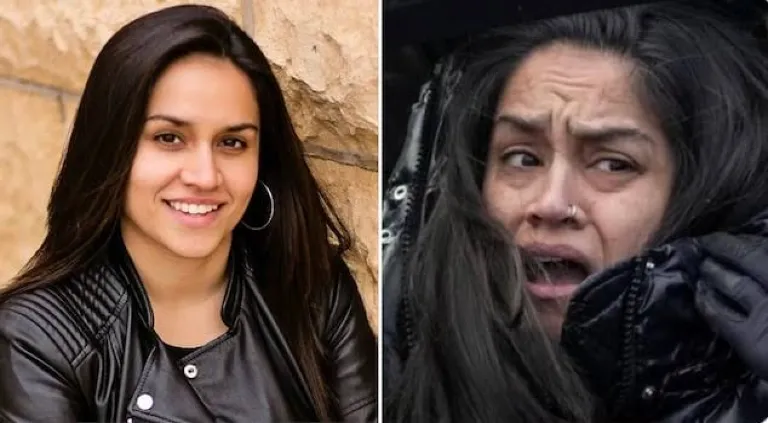
Minneapolis — Aliya Rahman, a United States citizen and resident of South Minneapolis, has publicly described her detention by federal immigration authorities, recounting a sequence of events she says left her seriously injured and traumatized.
Rahman, a Bangladeshi American born in northern Wisconsin, lives with autism and a traumatic brain injury, conditions she says were ignored during the encounter and subsequent detention.
Rahman said the incident occurred on January 13, while she was traveling to her 39th appointment at Hennepin County’s Traumatic Brain Injury Center.
According to her account, traffic was blocked by Immigration and Customs Enforcement (ICE) vehicles, with no visible detours or instructions.
As she attempted to navigate the situation safely, an agent allegedly shouted threats, including a warning to break her window.
Rahman described multiple agents surrounding her vehicle and issuing conflicting commands.
She said she struggled to process the instructions while watching for pedestrians.
Moments later, the passenger-side window shattered, sending glass across her face. Rahman stated that she repeatedly said she was disabled, to which an agent allegedly responded, “Too late.”
She recalled thinking of Ganoa Donald, an autistic Black man killed by police during a traffic stop in 2021, and Ciberga Gonzalez, who died during an ICE encounter the previous year.
Rahman said an agent displayed a large combat knife near her face, which she later learned was used to cut her seat belt.
Rahman reported intense pain to her head, neck, and wrists after being forced to the ground face-first.
She said officers leaned on her back as she lay restrained, triggering memories of George Floyd, who was killed just blocks away in 2020.
Rahman stated she was carried face down through the street by her arms and legs while handcuffed, repeatedly telling officers she had a brain injury and a disability. She says she now has lasting difficulty lifting her arms.
According to Rahman, she was never asked for identification, never informed she was under arrest, never read her rights, and never charged with a crime.
At the Whipple Federal Detention Center, Rahman said she witnessed detainees—whom she described as Black and brown—shackled and chained together, marched outdoors by shouting agents.
She said agents routinely referred to detainees as “bodies,” a term she described as dehumanizing and frightening.
Rahman stated she received no medical screening, no phone call, and no access to legal counsel. She said she requested a communication navigator when her speech became slurred but was denied.
She also said agents laughed when she attempted to stabilize her neck and refused to provide her cane.
She described being pulled up by her arms, fitted with leg irons, and urged to walk while agents mocked her condition.
When she was eventually placed in a wheelchair, an agent allegedly taunted her by saying that because she had been driving, her legs “must work.”
Rahman said she pleaded for emergency medical care for more than an hour as her vision blurred, her heart rate spiked, and pain intensified. She claims care was denied until she lost the ability to speak, at which point a cellmate pleaded on her behalf.
The last sounds she remembers before losing consciousness were her cellmate banging on the door and a voice outside making a comment she found disturbing.
Rahman awoke at Hennepin County Medical Center, where she learned she had been transported for treatment related to assault injuries.
She said the detention has had severe physical, mental, and financial consequences.
Despite her experience, Rahman emphasized that she does not seek special treatment.
“I do not deserve more humane treatment than anyone else,” she said, stressing that citizens and non-citizens alike deserve dignity and protection.
Rahman said she is speaking out for those who cannot—people still detained and families who have not been reunited. She linked her experience to the recent deaths of Alex Pretti and Renée Nicole Good, both U.S. citizens killed during encounters with federal immigration authorities in Minnesota.
She concluded by calling for accountability and clear rules governing the use of force by law enforcement.
Rahman said she is committed to continuing advocacy for reform, adding that she is not afraid to keep working toward change.
“I am here for a reason,” Rahman said. “And I will use my voice for those who can’t.”

